


Faced with the possible dangers of an economic crisis or a collapse in the value of the dollar, several so-called experts advocate a return to the gold standard, or suggest that individuals invest in gold, which they consider a "safe haven" investment.
They are mistaken. These "experts" admit that there is not enough gold to represent all the money needed in the economy but, they say, this is a good thing, because by tying the creation of money to gold, it limits the amount of money that governments can create and would therefore prevent inflation. They claim that if money is not based on gold, it is based only on confidence — that is, "on nothing, on no solid asset," according to them.
But this confidence is not nothing; it is the confidence that goods and services can be obtained in exchange for money. As we saw in the previous article, money is based on the existence of products, not on the existence of gold. Moreover, gold cannot be eaten; it is fruits, vegetables, and other foods that nourish us. Destroy all the production of farms and factories, and keep the gold — what will you live on?
Alain Pilote
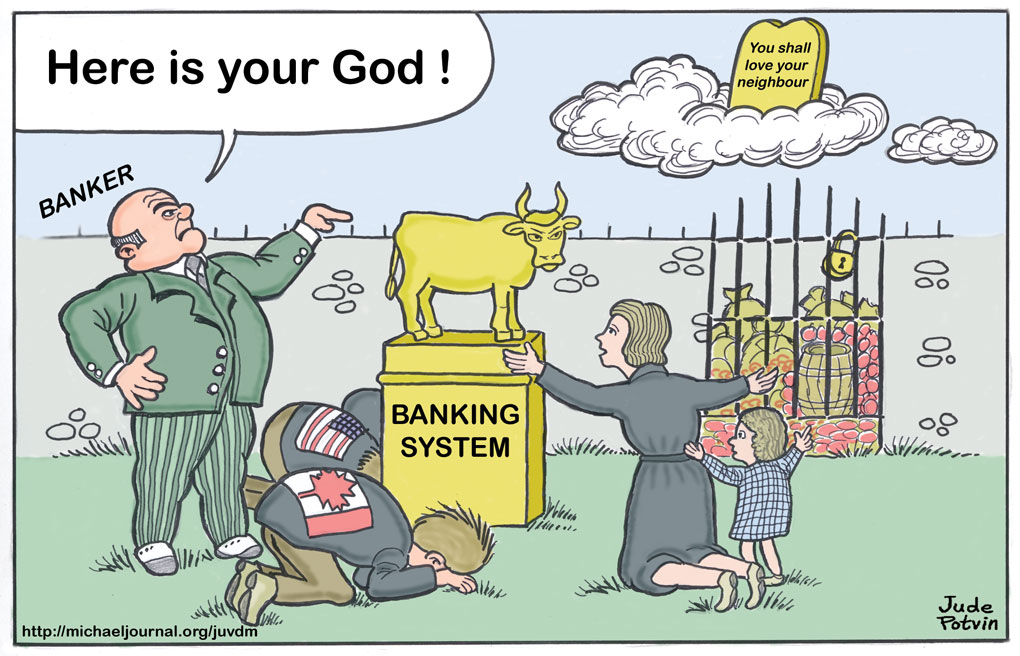 The new golden calf that we are being forced to worship
For millennia, gold has been valued for its beauty and scarcity, rather than for its chemical, physical, or technological properties. In fact, other metals and chemical elements have been more useful.
Its high value has been more subjective. Its beauty and scarcity confer privilege and prestige upon its possessor. Furthermore, its trade allows one to acquire other goods and buys influence… It signifies power.
Therefore, the struggle for gold has been relentless since antiquity.
Gold has also been used as currency, facilitating trade. However, it has been corrupted by banks with fiat money, symbolic money based on trust rather than the object itself. Bankers took advantage of this trust to grant loans with checks or promissory notes, representing gold that either did not exist or was insufficient.
Thanks to this trust, these notes circulated in commerce, representing gold that was supposedly always available. People preferred to hold other goods in their hands, such as food, land, tools, and clothing, and left their gold in the bank, as it solved nothing for them at home.
Thus, gold was a false backing that, nevertheless, drove the economy for centuries. And the US dollar was the main paper money that represented gold. Until, in 1971, gold, real or imagined, ceased to back anything. President Richard Nixon ended this dependence, as there was too much money in circulation and not enough gold to back it, so they removed it and continued issuing banknotes without the need for gold, as they had already been doing, but now without a legal obligation to possess it.
Simply changing the number or denomination of the banknote is enough to increase or decrease the value of that money, without having to increase the gold reserves.
Note that gold as a reserve is not truly money, unless it circulates as coins, fulfilling the functions of payment, deposit, savings, value, and exchange of goods and services… just as other forms of money have done, such as paper, cocoa, furs, stones, blankets, etc.
So why isn't gold backing the best option for the economy? There are many reasons:
Gold remains highly valued, and some believe it should once again back fiat currency. But only those who already possess that gold or can easily obtain it will say so. Again, the limited gold reserves would lead to an uncontrolled increase in the issuance of fiat currency to meet the demands of commerce, as has happened, even if the gold reserves are smaller and remain worth the same. This is illogical.
Besides being scarce, gold is hoarded by banking institutions, even by families, which means power and wealth are concentrated in the hands of a few. Thus, the economy fails to fulfill its basic function of satisfying needs of the people, which is reason enough not to return to the gold standard.
Any fiat money that originates as paper money representing gold will be concentrated in the hands of those who possess gold. And it will be distributed as a loan, that is, to be repaid, to be taken out of circulation and pay off the debt; and to remain the same in the best-case scenario, since interest worsens the situation, generating more scarcity and deficits. As we can see, this debt system is the source of the great paradox: the more money is issued, the less money there is.
Indeed, these debts are aggravated by the payment of interest, which exceeds the amount borrowed and is the banker's motivation. Interest that no one received and is not circulating, neither in paper nor in gold; and which keeps increasing, since this money takes many paths and is held up before it can be recovered within the payment deadlines. Even worse is when interest is applied to interest, compound interest.
Such monetary scarcity is what corrupts society with fraud, theft, inflation, labor exploitation, and everything that snatches more money. The easiest and quickest thing to do is raise prices—inflation. So, prices don't rise because everyone has more money in their pockets, but because of a lot of debt to pay to the holders of gold.
To speculate is to tempt the ever-dissatisfied poor, who always need more. So, gold surpasses its subjective and official value, and those who possess it can speculate on its sale, raising and lowering its price at will; or reducing the amount of gold in circulating coins. All this is done to hoard more and become even richer with all the goods and services that gold represents.
The desire to hoard more gold and money stems from the egocentrism of competing to save oneself and one's own kind. It's assumed that the monetary system is unfair and could ruin many people, and only the hoarders survive. This doesn't foster cooperation and healthy coexistence, but rather greed, envy, and war.
It's difficult to control or even know the gold reserves of each country, whether in vaults or even in nature. It's easy to boast about or hide; no one really knows how much exists or where it is. Extraction costs can vary. And it doesn't circulate. When is it scarce or not? When does its price rise and fall? Who decides that? The only certainty is that gold generates even more debt and monetary scarcity.
The gold standard, however, requires a global reference currency, as the US dollar has unfairly been. This eliminates the possibility of monetary sovereignty to issue one's own money, free of debt, in different countries. Backing it with oil would also be unjust—even though it is more valuable due to the vast amount of wealth and goods it generates.
Advances toward the digitalization of money do not require backing from any intrinsic value like gold. That is, gold goes against the most efficient technocratic trends—although these have other shortcomings, such as the lack of democracy and honesty in those who manage digital money, and the danger of control if paper money is abandoned.
In addition to the labor exploitation that gold has entailed, ecological degradation stands out. Many communities around the world suffer from these exploitations by mining companies that pollute and hoard water, to the detriment of the local economy. Furthermore, community leaders are murdered with complete impunity and government complicity, as in Mexico.
In short, unjust and inequitable money worsens if we return to the gold standard. In the end, gold only represents an obstacle and an obsolete model for creating the sufficient money that economic activities need today, without contributing to society.
In contrast, proposals for Economic Democracy seek the distribution of fiat money to meet everyone's basic needs, whether paper or digital, without debt. Gold backing is not required.
However, private entities create money for their own benefit, while for the people it represents debt and a means of social control. And the world's governments, due to their lack of democratic controls and their commitments to banks, are incapable of achieving economic democracy.
Citizens must implement their own autonomous, alternative, debt-free currency, independent of governments and the international financial system, or it will not be possible.
Until now, the best way to generate this monetary abundance has been through community currencies at the local level. These are democratic experiences where participants make their own decisions and create autonomous currencies, alternative markets, and a more artisanal but more humane production. There are no debts, no interest, no taxes. It's not about importing or exporting, but about developing the regional economy.
Thus, these currencies strengthen as they can acquire more goods and services around the world.
Study Session on Economic Democracy And Annual Congress
Discover C.H. Douglas’s proposals for economic and social renewal with the Pilgrims of St. Michael in Rougemont, Quebec Canada from Sept. 23 through September 28 2026.
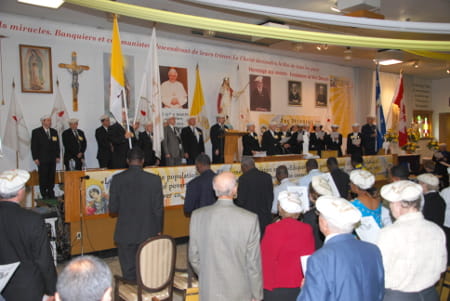
Rougemont Quebec Monthly Meetings
Every 4th Sunday of every month, a monthly meeting is held in Rougemont.

 Subscribe