


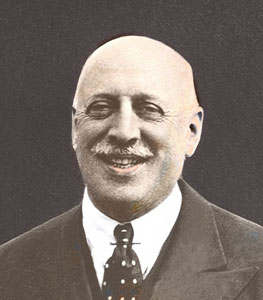
On November 30, 2025, Father Pierre Claver Nzeyimana (picture), parish priest of Rougemont (as well as of four parishes forming the Marieville pastoral unit in the Diocese of Saint-Hyacinthe), came to our monthly gathering at the House of the Immaculate in Rougemont to give a talk. Here are excerpts from this conference:
Dear Pilgrims of St. Michael, brothers and sisters in Christ, it is a profound joy to be among you today, on the first Sunday of the Advent season 2025, at the heart of this place marked by spiritual commitment, prayer, social action, and reflection. You truly bear your name well: pilgrims. What does this term "pilgrims" evoke? May I also call you "pilgrims of hope"?
It is certain that this theme, "pilgrims of hope," which we wish to explore today, evokes people who are on the move. It therefore invites us to reflect on what it means to walk in today's world—a world marked by economic, social, ecological, and spiritual crises. This leads us to consider hope, from the outset, as a way of being, an attitude, almost a "form of life," to use an expression dear to phenomenology. Hope then becomes our way of inhabiting the world, of experiencing it, of being aware that we are not alone on life's journey but that we are "beings-with-others."
And in order to understand this "form of hope," I propose that we allow ourselves to be guided by the philosophy of certain phenomenologists whose works enable us to weave a fruitful dialogue with the social teaching of the Catholic Church. For there exists a profound convergence between these thinkers and the Church's social doctrine. All affirm that the human being, in order to become truly himself or herself, must learn to perceive the world as a "promise," a "gift," or, to use Christian language, as a gift from God that calls for response, responsibility, and communion.
Phenomenology, in its essence, is not a complicated philosophy. It begins with a very simple gesture: learning to see — to see what appears, to see what is given, to see what reveals itself, to see differently. Thus, before thinking, before analyzing, before acting, phenomenology first asks us to welcome. And welcoming is precisely the first gesture of hope.
Hope, then, can be understood as a phenomenon that precedes us and is given to us. It must be welcomed in the time and space in which we find ourselves, in and with the world that is ours.
In The Poetic, Dufrenne affirms that the world is not only what presents itself, but what offers itself — what calls for a response. This idea is fundamental. It means that the world is never neutral. It is filled with meaning, possibilities, appeals, and promises.
For Dufrenne, the human being is not merely an observer or a spectator, but an actor — one who responds to the coming of the world. And in one way or another, to "respond" is to "hope".
This is why, in the mind of the Catholic Church, hope is understood as a virtue — a dynamic virtue, a driving force. It is a movement of desire oriented toward service, a kind of engine of transformation and propulsion. Hope becomes a way of inhabiting reality, of responding to the needs that our world constantly places before us. (...)
Paul Ricoeur defines hope as an openness to a future that is not merely the continuation of the present (History and Truth, p. 123). In other words, hope is not naïveté. It is the capacity to believe in newness, in the possibility of what seems impossible, despite appearances.
Hope opens time; it prevents the present from closing in on itself. When the world seems blocked, closed off, without a way forward, hope opens a path.
This is precisely what you live, dear Pilgrims of Saint Michael: your spiritual journey is not a mere ritual; it is a gesture of openness that refuses to allow history to close in on itself. Your mission is a concrete sign that hope can become social action, education, shared work, and commitment within the community. You are turned toward those in need. You are concerned for their future. And you work to help build a better future for them by protecting their human dignity, which is threatened by various contemporary political and social systems. The face of the other speaks to you, challenges you, calls you, and sets you on the path of responsibility and commitment.
In short, in a world marked by loneliness, social fragmentation, and economic tensions, being pilgrims of hope becomes an indispensable witness and a real necessity in order to heal the situation of so many people whose very existence is being trampled upon. For to be pilgrims of hope is to take responsibility for one another, with the certainty that the modern world, whatever it may be, can never destroy hope.
Thus, being pilgrims of hope does not mean living in a nostalgic way or indulging in illusion. On the contrary, it means being able to read crisis as a kairos — a timely moment of grace in which renewal can emerge. It is precisely in times of crisis that a renewed sense of responsibility should arise. For crisis is not only a lack; it is also an ethical invitation, a call to protect the other. The world cries out for help, and the human person hastens to respond.
Justice is not first and foremost an institution. It is a hope for recognition. To be recognized is to be perceived not as an object, but as a subject worthy of respect. In the spirit of the Church's social teaching, all hope must be grounded in the dignity of the human person.
To be pilgrims of hope in our world is to bear witness to a humanity that recognizes itself, respects itself, and rises again. For believers, this implies concrete commitments: an economy at the service of the human person; the defence of the poorest; welcoming the stranger; protecting families; rejecting violence; and working for the common good.
The other then ceases to be a threat and becomes a brother or sister to be loved and served, in the peace that should characterize us as children of the same Father. We open ourselves to the other and encounter their presence within our own presence. And they, in turn, rejoice in making the same experience with us.
Thus, being pilgrims of hope, in this perspective, means: learning to allow ourselves to be touched; accepting to be disturbed; renouncing the temptation to withdraw; becoming responsible for our neighbour; and accepting that responsibility for the other must always come before any decision we make.
In Gaudium et Spes, the Second Vatican Council tells us: "It is the duty of the entire People of God to scrutinize the signs of the times" (§4). This expression — "signs of the times" — is strikingly phenomenological. It means that the world is not merely a collection of facts; it is a text, a phenomenon, a call to interpretation.
Thus, being pilgrims of hope today involves three fundamental attitudes:
a) Seeing: the Church asks us to "open our eyes," not to allow ourselves to be blinded by confusion or fear.
b) Discerning: phenomenology teaches us to distinguish what is essential from what is accidental, the call from illusion.
c) Acting: the Church's social doctrine constantly reminds us that we cannot hope without transforming the world — without working for justice, solidarity, and peace. Pope Francis affirms in Evangelii Gaudium: "Hope is never passive. It is combative" (no. 86).
The Pilgrims of Saint Michael, inspired by the social, economic, and spiritual intuition of Louis Even, are a concrete response to this call of a world that keeps modernizing while destroying itself. Your tradition insists on the dignity of every person; respect for the family; economic justice; community solidarity; the sovereignty of peoples; the importance of education and formation; and the defence of the most vulnerable.
Thus, to be pilgrims of hope, within your missionary vocation, always means: walking together; restoring confidence to those who doubt; defending justice and peace; protecting the poor and creation; refusing fatalism; believing that another world is possible; and bearing witness to light in the midst of the darkness that confronts us.
Dear pilgrims, you bear a name that says what is essential: you are on a journey —journeying with your brothers and sisters, journeying with the Church, journeying with those who suffer, journeying for a more just world, journeying toward the Kingdom, journeying in the Light, and above all journeying with Christ, who is our way, our truth, and our life. May this conference not be merely a word heard, but a word received, a word lived, a word set in motion. And may we together truly become pilgrims of hope —for our Church, for our society, and for the whole world.
Father Pierre Claver Nzeyimana
Study Session on Economic Democracy And Annual Congress
Discover C.H. Douglas’s proposals for economic and social renewal with the Pilgrims of St. Michael in Rougemont, Quebec Canada from Sept. 23 through September 28 2026.
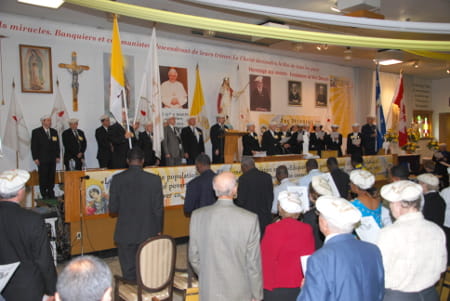
Rougemont Quebec Monthly Meetings
Every 4th Sunday of every month, a monthly meeting is held in Rougemont.

 Subscribe