


On February 9, 2026, Bishop Louis Tylka, Bishop of the Diocese of Peoria, Illinois, in the United States, joyfully announced the news that many had long awaited: the Vatican had given the green light for the beatification of Bishop Fulton Sheen (1895–1979), bishop and renowned preacher on American radio and television, one of the first to understand the importance of the media for spreading the Catholic faith.
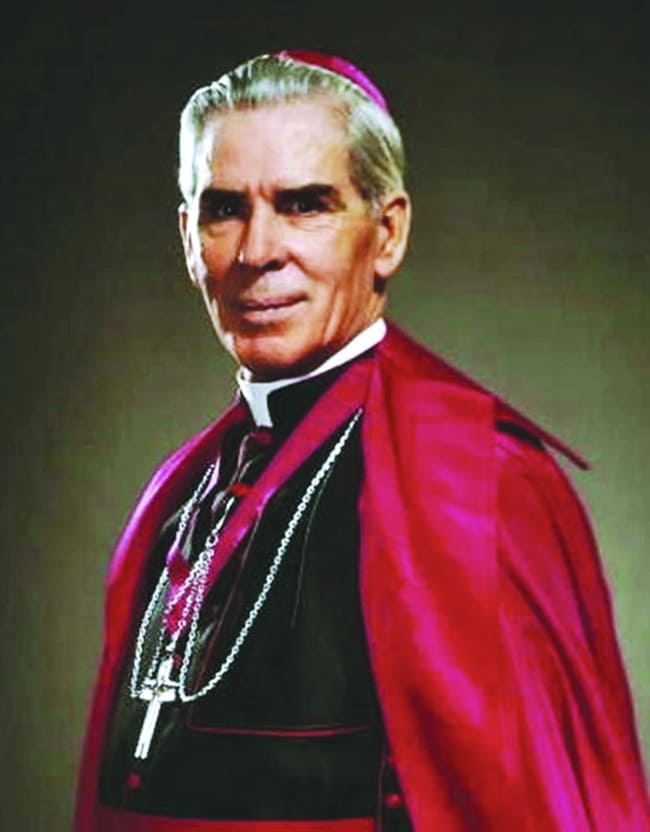 Bishop Fulton Sheen
What is quite remarkable in this case is that Bishop Sheen's beatification had to overcome two serious obstacles before reaching this point.
First, the beatification had originally been scheduled for December 21, 2019, at the Cathedral of Peoria — where Fulton Sheen had been ordained a priest 100 years earlier, in 1919 — after Pope Francis approved in July 2019 a miracle attributed to Bishop Sheen's intercession. (This miracle, the details of which will be discussed on page 30 of this issue, occurred in 2010.)
However, to everyone's surprise, on December 3, 2019, just two weeks before the scheduled ceremony, the Bishop of Peoria announced that the beatification had been postponed indefinitely by the Vatican. The delay followed a request from certain American bishops, including at the time the Bishop of Rochester, Bishop Salvatore Matano, who asked for a postponement out of concern that allegations related to the handling of clergy abuse cases might be raised against Bishop Sheen, who had served as Bishop of Rochester from 1966 to 1969. Obviously, no fault or wrongdoing on the part of Bishop Sheen was ever found, and with the Vatican's permission, the beatification will therefore take place in 2026, likely next September.
A second obstacle had already arisen in September 2014. After a panel of seven Vatican medical experts unanimously concluded that there was no natural explanation for the 2010 healing, the cause for Bishop Sheen's beatification was suspended due to a legal dispute between the Archdiocese of New York, custodian of Bishop Sheen's mortal remains (buried in St. Patrick's Cathedral in New York), and the Diocese of Peoria, which wished to receive them. After several legal proceedings, the Archdiocese of New York agreed on June 9, 2019, to transfer the body to Peoria, thereby allowing the cause to move forward.
Bishop Sheen was not an ordinary bishop. He was one of the greatest communicators of the faith in the twentieth century. From 1951 to 1957, his television program Life Is Worth Living attracted more than 30 million viewers each week, Catholics and non-believers alike. In 1952, Bishop Sheen even won an Emmy Award as "Most Outstanding Television Personality". Accepting his award, with his characteristic humour, he declared: "I wish to thank my four writers — Matthew, Mark, Luke, and John."
Here is a summary of the life of this extraordinary bishop and future Blessed, as published in the May 2016 spiritual newsletter of Saint Joseph Abbey of Clairval, France (www.clairval.com):
by Dom Antoine-Marie, O.S.B.
On October 2, 1979, in Saint Patrick's Cathedral in New York, in front of a huge crowd of worshipers who had come to greet the Supreme Pontiff, a venerable octogenarian among the American bishops came forward with difficulty, and knelt down. John Paul II raised him to his feet and embraced him, saying: "You have written and spoken well of the Lord Jesus Christ. You are a loyal son of the Church."
(Editor's note: This bishop was Fulton Sheen. Despite his fragile health, he still wished to take part in the meeting with John Paul II during the Pope's apostolic visit to the United States. On that occasion, he arrived at St. Patrick's Cathedral in New York by ambulance. Bishop Sheen passed away a few weeks later, on December 9, 1979.)
The crowd was touched by this gesture, and the prelate was deeply moved by the Pope's words. Nothing could have given Archbishop Fulton Sheen more joy, at the end of a life entirely devoted to the love of Jesus Christ and His Church. In his own words: The Church is "the Temple of Life in which I am a living stone; it is the Tree of Eternal Fruit of which I am a Branch; it is the Mystical Body of Christ on earth of which I am a member. The Church is therefore more to me than I am to myself… So absorbing does she become that her thoughts are my thoughts; her loves are my loves; her ideals are my ideals. I consider sharing her life the greatest gift God has ever given to me, as I should consider losing her life the greatest evil that could befall me… My life is her life, my being is her being, she has my love, my service."
Archbishop Sheen was born on May 8, 1895, in El Paso, Illinois, is the first of four boys born to Newton Sheen and Delia Fulton, who managed a modest hardware store. The day of his Baptism, he was placed on the altar of the Virgin as a sign of special consecration to the Queen of Heaven. At Baptism he received the names Peter and John, but he would commonly be called by his mother's maiden name, Fulton, and it was by this name that he would be known.
F ive years later, for economic reasons, the family was forced to move near the city of Peoria. There, the child successfully completed his elementary and secondary schooling. Throughout his life, he would be grateful for having had profoundly Catholic parents. "The best influences in life," he would write, "are undeliberate, unconscious; when no one is watching, when reaction to the good deed was not sought. Such is the long term influence of a mother at home; fulfilling her daily duties with love and a spirit of self-sacrifice, she leaves an imprint on the children that deepens with the years."
Fulton had a normal schooling and proved to be an all-around excellent student. Summers, he helped his father on the farm, despite his lack of attraction to farm work, since his interests were intellectual. One day a neighbor told his father: "That oldest boy of yours, Fulton, will never be worth a damn. He's always got his nose in a book." After high school, the young man entered university, where his success earned him a scholarship for a doctorate. However, he felt the Lord's call to the priesthood. He asked the advice of a good priest, Father Bergan, who answered him flatly: "Tear up the scholarship. That is what the Lord wants you to do; trusting in Him, you will receive a far better university education after you are ordained than before." Fulton then decided to enter the seminary. He would never regret it.
On September 20, 1919, the day of his priestly ordination, he made two promises: to spend an hour before the Blessed Sacrament every day of his life, and to celebrate the Mass every Saturday in honor of the Blessed Virgin Mary, so as to solicit the protection of the Queen of Heaven for his priesthood. He would later speak of the "deep ecstatic sense of love that comes with ordination, and spoils us for all other love." The Holy Hour would become the frequent subject of his reflections and preaching, especially when he would speak to priests. He maintained that it is impossible for a priest to give Christ to others if he does not spend considerable time each day in His presence: "Neither theological knowledge nor social action alone is enough to keep us in love with Christ unless both are preceded by a personal encounter with Him."
Why? Because it is a question of love, and love demands that one spend time with the beloved: "Very few souls ever meditate; they are either frightened by the word, or else never taught its existence. In the human order a person in love is always conscious of the one loved, lives in the presence of the other, resolves to do the will of the other, and regards as his greatest jealousy being outdone in the least advantage of self-giving. Apply this to a soul in love with God, and you have the rudiments of meditation."
Shortly after his ordination, Fulton enrolled in the Catholic University of America, in Washington, where he earned degrees in theology and canon law. Rather than continuing his studies in America, he asked to earn his doctorate at a European university, and chose the University of Louvain, in Belgium. After receiving his doctorate in July 1925, Sheen passed further exams qualifying him to be a professor of philosophy at the highest level. But then he was appointed vicar in a poor parish in his native diocese of Peoria, Illinois.
After the studies he had just completed, many were surprised at this appointment, which seemed humiliating for so brilliant a priest. But he gracefully accepted this ministry. He threw himself completely into the pastoral care of souls, and soon becoming the friend of all, obtaining numerous conversions. At the end of eight months, the bishop admitted to him, "Three years ago I promised you to the faculty of the Catholic University of America, but everyone said you'd gotten so high-hat in Europe that you wouldn't take orders any more. But you've been a good boy, so run along."
Father Sheen would remain in Washington for more than twenty years, much appreciated by his students: "You'd no more think of raising a hand in one of his classes," one of them later said, "than of telling the sun to stop shining for a minute. Nor can I honestly say you'd want to. He was that spell-binding a teacher." The young priest considered teaching to be "one of the noblest vocations on earth, for, in the last analysis, the purpose of all education is the knowledge and love of truth."
His intellectual capabilities did not prevent him from remaining very close to the simple faithful all his life. Showing great kindness towards all, he never dazzled others with his learning. Rather, he strove to always learn something from the person with whom he was speaking. In his teaching, he began by placing himself at the level of his students, so as to gradually raise them higher.
His full-time professorship did not keep him from accepting numerous invitations to preach retreats or give talks. He prepared his talks with great care, always speaking standing up and without notes; he liked to say that no one starts a fire sitting down. His clear and precise presentation of the truths of the Catholic faith was peppered with humorous anecdotes that kept the audience's attention.
Very soon his reputation spread far and wide. He felt real faith was what was most lacking in the world. So he did not hesitate to confidently remind his listeners of the great truths of the Gospel, which, when meditated upon, bring about the conversion of souls: death, judgment, heaven, and hell. For him, modern man wanted the impossible: a religion without the Cross, a Christ without Calvary, a kingdom without justice, and in his church, "a soft dean who never mentions hell to ears polite."
But that is not the faith of the Church. In fact, during the judgment, he reminds us, "each man will have to learn for himself that narrow is the gate and strait the way to Eternal Life, and few there are who enter therein… There all the masks will be taken off; he will step out of the ranks, away from the crowd, and the only voice he will hear will be the voice of conscience, which … will reveal self as he really is; … No opiates will be served to make him forget or waft him off into the delightful irresponsibility of sleep; no cocktails will be served at heavenly bars with angelic barmaids to make him deaf to the voice of conscience."
Half a century later, Saint John Paul II would similarly write: "Nor can the church omit, without serious mutilation of her essential message, a constant catechesis on what the traditional Christian language calls the four last things of man: death, judgment (universal and particular), hell and heaven … Only in this eschatological vision can one realize the exact nature of sin and feel decisively moved to penance and reconciliation" (Exhortation Reconciliatio et Paenitentia, December 2, 1984, no. 26).
Beginning in 1928, Father Sheen's voice was regularly broadcast over the airwaves in the program "The Catholic Hour". For over twenty years, he strove to present to his listeners, in simple terms, the contents of the Catholic faith, which he defended against modern attacks. He received many letters (between 3,000 and 6,000 per week) as a result of these broadcasts. Many correspondents sent money, which he generously redistributed to the needy. "In time God replaces any energy or money that is given away," he replied to those who complained about his generosity. In 1934, his renown resulted in his being named a Papal Chamberlain with the title "Monsignor." In 1951, he was invited to preach the Gospel on television in a series called "Life Is Worth Living." This apostolate would last seven years.
For decades Monsignor Sheen remained a leading figure in the fight against Communism. Rather than making only the Russian revolutionaries responsible for the success of this ideology, he did not hesitate to attribute its success to a secularized West that had lost the faith, the source of its grandeur: "As Western civilization loses its Christianity it loses its superiority. The ideology of Communism rose out of the secularized remnants of a Western civilization whose soul was once Christian." Moreover, he predicted that the moral decadence of the West would lead to its certain collapse if it did not undertake a serious reform. Citing the historian Arnold Toynbee, Sheen pointed out that "sixteen out of the nineteen civilizations which have decayed from the beginning of history until now, decayed from within."
Writing his books (he wrote 66) and carefully preparing his homilies, talks, and televised broadcasts took a great deal of time; despite this, he found a way to visit the poor, the sick, and distant missions in the Third World, to personally respond to tens of thousands of letters, and to instruct a great many people who were coming to or returning to the faith. He insisted that God's grace seeks out a soul that is open to it. He liked to say "the latch is on our side and not on God's," and "God does not break down doors. It is we who bar His entrance."
He reflected on the modern phenomenon of atheism: "Atheism, nine times out of ten," he declared, "is born from the womb of a bad conscience. Disbelief is born of sin, not of reason." And he gladly advised those who found themselves in this situation: "If you want to know God, there is only one way: get down on your knees… If you do not worship God, you worship something, and nine times out of ten it will be yourself."
It is impossible to count the number of people who were converted by this tireless apostle. "I never keep a record of converts," he admitted, "lest I fall into the error of thinking I made them. The Good Lord would never let me have another. He would punish me for my pride." A man who walks under trees laden with ripe apples gathers them effortlessly. In the same way he recognized that every conversion is first and foremost a gift from God, granted through prayer, without which nothing good can be done in the order of grace.
Fulton saw the wars that took place over the course of his life as the result of a multitude of sins. Indeed, violation of the moral law in and of itself incurs grave consequences—it is sin that brings suffering. In response to those who point the finger at God, making Him responsible for evil, he wrote, "The only time some men… ever think of God is when they want to find someone to blame for their own sins. Without ever saying so, they assume that man is responsible for everything good and beautiful in the world, but God is responsible for its wickedness and its wars… They ignore the fact that God is like a playwright who wrote a beautiful drama, gave it to men to act with all the directions for acting, and they made a botch of it."
Confronted with unbelievers who ask, when everything is going wrong, "Where is God?" he replied, "Where are your gods now? Where is your god Progress in the face of two world wars within 21 years? Where is your god Science, now that it consecrates its energies to destruction? Where is your god Evolution now that the world is turned backward into one vast slaughterhouse?"
After his consecration as a bishop in Rome, on June 11, 1951, Bishop Fulton Sheen was named an auxiliary bishop of New York. He carried out this ministry for fifteen years, while leading the Society for the Propagation of the Faith, an organization charged with coordinating aid to the missions for all the American dioceses, in concert with the Holy See. In this role, he collected considerable sums for the missions. His episcopal coat of arms bears the Latin motto Da per matrem me venire, which may be translated as this filial prayer: "Grant that I may come through the Mother." In its own way, it summarizes one of the central themes of his spirituality: trust in Marian intercession, united with a fervent Eucharistic faith.
But his fame, and the money that passed through his hands, drew jealousy and criticism. A dispute with a high ecclesiastical dignitary (Cardinal Spellman of New York City) over a governmental gift on behalf of the missions would remain a painful thorn for him for a decade. Paradoxically, this conflict helped him progress in the night of the faith, and discover the mysterious joy of suffering with the Savior: "Unless there is a Good Friday in our lives there will never be an Easter Sunday," he wrote. "So essential is dying to self the prelude to the true life of self." During a trip to the Holy Land and other places linked to biblical history, Bishop Sheen stopped in Ephesus, a city evangelized by Saint Paul, who nearly lost his life there (cf. Acts 19). "Ephesus taught me," said the prelate, "that preaching the Word will always provoke antagonisms. Whether it be against Communism or against greed, whether it be directed against divorce or abortion, there will be not only individual harassment but organized revolt."
Bishop Sheen participated in all the sessions of the Second Vatican Council, making several interventions. In 1966, he was named bishop of Rochester, a position he would assume for three years. In 1969, he officially retired and received at this time the honorific title of archbishop. However, his activity did not lessen—talks and conferences in front of the most diverse audiences took him across the United States and Europe.
He even found the energy to do a new television series titled "What Now, America?" It was as though he wished to die in harness! The years following the Council were marked by great sufferings—while he was delighted about some reforms, he was deeply troubled by the confusion that seemed to prevail in the Church. "We have distanced ourselves from the standard of Christ to move towards the standard of the world. We do not ask ourselves,'Does this please Christ?'but'Does this please the world?'So I will dress and act in such a way that I will not be separate from the world; I want to be with it. We marry this age, and we become a widow in the next one. We take on its verbiage, its fashions. This is one reason for so much instability in the Church today: the sand on which we are walking is shifting. We've given up the rock which is Christ."
In 1976, the archbishop emeritus went to Rochester for the dedication of the Sheen Archives, a collection of his writings and recordings established at the diocesan seminary. On this occasion, he confided the following to those who hoped to find his "secret" in these archives: during his trips to Paris, he loved to visit a former Carmelite monastery that had been converted into a student residence. "There," he said, "there is one room that I always visit. It's at the end of a corridor… and over the desk was carved a peephole.
"It was the room of the great preacher Lacordaire, and as he sat at that desk he could look through that peephole, and what did he see? He looked on the tabernacle—He looked on the Blessed Sacrament. It was that that made Lacordaire great. There is no complete explanation of Fulton J. Sheen in these books, in these tapes. You have to look for a secret from the outside, where knowledge is converted into wisdom, and that is done only at the feet of Christ and his Blessed Sacrament. So may all who enter this room be reminded of a peephole. Look through it, and you'll explain Fulton John Sheen."
In 1977, his health began to fail. He underwent open heart surgery, never before attempted on a man his age. As soon as possible afterwards, a priest came to celebrate Mass at the foot of his bed. The suffering archbishop managed to whisper the words of consecration and, gasping, he gave an explanation of the Mass to one of the attendants who was not Catholic. Even in these extreme circumstances, he took seriously the words of Saint Paul the Apostle: Woe to me if I do not preach the Gospel! (cf. 1 Cor. 9:16) One evening, while he was in intensive care and barely conscious, he heard a nurse speak about another patient who was dying in a nearby bed. Unable to raise his hand, Sheen lifted his finger and traced the sign of the cross towards the dying man, giving him conditional absolution on the threshold of eternity.
In September 1978, he returned to the hospital for four months. He wrote to a cousin: "I have no complaint whatever about my condition because I firmly believe that the Lord often puts us on our back so that we will keep looking up to heaven." During this stay, he consoled an elderly man and brought him back to the faith, after he had been away from the Church for forty-five years and had tried to kill himself. After several hours of conversation, Archbishop Sheen heard his confession, reconciled him with the Church, and gave him Holy Communion. This event was a tremendous consolation for the aging archbishop, who saw in it a fruit of his own sufferings willingly accepted: "I had asked the Lord to let my sufferings do some good for some soul and He had answered the prayer."
Tireless, he returned to his activities once released from the hospital. In January 1979, he was invited to the National Prayer Breakfast in Washington, in the presence of Jimmy Carter, then president of the United States. The venerable prelate began his speech with these words: "Mr. President, you are a sinner." After a moment of silence, he continued, "I am a sinner." Then, scanning the celebrities in attendance: "We are all sinners, and we all need to turn to God." Billy Graham, who was present, would declare that this was one of the most eloquent and inspiring sermons he had ever heard.
On Good Friday of that year, greatly weakened by his intense sufferings, Archbishop Sheen climbed the pulpit of Saint Agnes'Church in New York for the last time, determined to give a homily, even if it cost him his life. He had always thought that the pulpit would be a good place to die. But the months passed… Finally, on December 9, 1979, Fulton Sheen obtained the grace he had often asked for: to die before the Blessed Sacrament. A short time before, he had confessed his desire to leave this life: "It is not that I do not love life; I do. It is just that I want to see the Lord. I have spent hours before Him in the Blessed Sacrament. I have spoken to Him in prayer, and about Him to everyone who would listen, and now I want to see Him face to face."
Archbishop Sheen's cause for beatification, opened in 2002, resulted in the 2012 declaration of his heroic virtues. From that point on, he bears the title "Venerable ". As we pray for his canonization, let us ask him to share with us his intense love for Jesus in the Eucharist, and his solicitude for the eternal destiny of souls.
Dom Antoine-Marie, O.S.B.
This article is reprinted with permission from the Abbey of Clairval, France, which every month publishes a spiritual newsletter on the life of a saint,. Their postal address is Dom Antoine Marie, Abbe, Abbaye Saint-Joseph de Clairval 21150 Flavigny sur Ozerain, France. The website is http://www.clairval.com
Study Session on Economic Democracy And Annual Congress
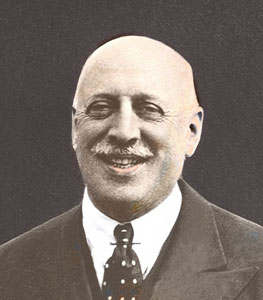
Discover C.H. Douglas’s proposals for economic and social renewal with the Pilgrims of St. Michael in Rougemont, Quebec Canada from Sept. 23 through September 28 2026.
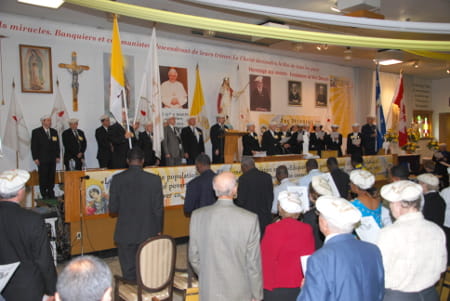
Rougemont Quebec Monthly Meetings
Every 4th Sunday of every month, a monthly meeting is held in Rougemont.

 Subscribe