


To speak of full employment, that is, of universal employment, is to make a contradiction with the pursuit of progress in the techniques and processes of production. New and more perfect machines are not introduced to tie man to employment, nor are new sources of energy tapped for this end, but rather are they brought into production for the purpose of liberating him from work.
But, alas, we seem to have lost sight of ends. We are confusing means and ends. We mistake the former for the latter. This is a perversion which infects our whole economic life and makes it impossible for men to enjoy to the full the logical rewards of progress.
Industry does not exist to give employment but to furnish products, goods. If it succeeds in furnishing such products then it has accomplished its purpose, met its end. And the more completely it meets this end with the minimum of time and the minimum employment of human hands, the more perfect it is.
Mr. Jones, for example, buys his wife an automatic washing machine. Now the weekly wash will take only a quarter of the day instead of a full day. When Mrs. Jones puts the clothing in the washing machine along with the soap, when she turns on the taps bringing in the proper mixture of hot and cold water, she has nothing more to do except turn on the machine. The machine washes the clothes, rinses them, and then stops automatically when the clothes are ready to come out.
Is Mrs. Jones going to bemoan the fact that she now has more time to do with what she pleases? Or is Mr. Jones going to search for another type of work to replace that from which his wife has been freed? Certainly not. Neither one is that stupid.
But we do find such stupidity running rampant in our social and economic life, for the system makes progress penalize the individual instead of bringing him relief, in that it persists in tying purchasing power, the distribution of money, to employment, and employment alone employment in production. Money comes only as a recompense for effort and labor in production.
The role of money has also been perverted. Money, basically is nothing more than a ticket which we present in order to obtain goods or services. It is a ticket which is universally valid permitting the purchaser to buy what he wants and making available to him the entire market of goods and services. He has at his disposal the entire production of the country.
If it is desirable that the economy of the country fulfill its reason for existence which is to satisfy human needs, then individuals must have sufficient of these "tickets" to lay hands on enough products, in so far as the country's capacity for production can meet such demands. The volume of money with which to buy goods should be regulated by the sum total of goods and services offered and not by the sum total of work necessary to produce them.
It is true that production distributes money to those who are employed in the work of producing. But this is as a means and not as an end. The end of production is not to supply money but to furnish goods and services. And if production is able to replace twenty salaried individuals by the introduction of one machine it has not in any way thwarted its true purpose. And if it could furnish all the production necessary for humans and not distribute one cent of money, it would still be meeting the end for which it exists to furnish goods and services.
In freeing men from labor, industry should certainly receive the same gratitude which Mr. Jones received from his wife when he liberated her from hours of work by purchasing an automatic washing for her.
But how can a man say "thank you" when he has been liberated from work by a machine but finds to his consternation that he has no money?
And this is precisely where our economic system has become defective in that it has not adapted its financial mechanism to its productive mechanism.
In the measure that industry or production passes out of human hands so to should purchasing power, in the form of money, be channeled to consumers through some other means than recompense for employment.
In other words, the financial system should harmonize with production not only with respect to volume but also with respect to the manner in which it is distributed. If production is abundant then money should be abundant. If production is liberated from human labour then money should be disassociated from employment.
Money is an integral part of the financial system and not a part of the production system properly so-called. When the production system finally reaches a point where it can distribute goods without the aid of salaried individuals, then too the financial system should reach the point where purchasing power can be distributed by some other means than salaries.
If such is not the case it is because, unlike the production system, the financial system has not adapted itself to progress. And it is precisely this difference which has given rise to grave problems, when in fact progress should make all problems of such a nature disappear.
Replacing men by machines in production should lead to the enrichment of men, to his deliverance from purely material worries and cares, permitting him to give himself over to other human pursuits besides those which are related solely to the economic function. If, to the contrary, such a substitution leads to care and privation this is because we have refused to adapt the financial system to this progress.
Our physical capacity to produce no longer poses any problem to the producing, easily and efficiently, of all that is required by normal needs. And we have all the means to transport and distribute such production. If the financial system truly reflected this state of affairs, it, neither, would pose any problems. There would be no financial problem just as there is no production problem and no problem in transportation and distribution. But finance does not reflect the realities of production and distribution. It is in flagrant opposition to such realities.
Our financial system is as false as a map which would put Toronto to the east of Montreal. A traveller who set out for Toronto, following such a map, would soon end up in the gulf of St. Lawrence. The further he went the further he would be from his goal.
Nevertheless, the financial system, which is not a thing devised by the Almighty, was invented by men certainly to serve our economic life and not to command it, much less tyrannize it. It should, then, reflect the realities of our economic life at all times.
In a primitive economy, where production depends almost solely upon the employment of all available hands all the time, the right to the fruits of production might quite justifiably be tied to employment in production. A financial system, then, which distributes purchasing power only through salaries paid to employment in production might be quite suitable in a primitive economy.
At the other extreme, that of total automation, where all production flows forth without the need of a single human hand, any financial system which tied the distribution of purchasing power uniquely to employment would achieve absolutely nothing. In such a hypothesis then, in order to give to consumers the "tickets" which will permit them to choose what goods they need, and thus, incidentally, guide the activities of automated production, it is necessary to find a means for distributing this purchasing power absolutely disassociated from employment, for employment will no longer exist.
This purchasing power, disassociated from employment, the Crediters call the dividend. And it is a particularly suitable word. The dividend which the capitalist receives is something quite apart from their employment. It is the employment of others which brings in this dividend. Likewise, in the hypothesis of completely automated production, the consumers' dividend would be completely disassociated from their employment; it would be the employment of progress which would bring them their dividend.
Such a dividend would necessarily be the same for all, for it would be earned by no individual. This would be a dividend whose capital would be the greatest of all capitals, the preponderant factor in modern production, that is, progress; progress which has been built up by generation after generation and handed down from one to the other. It is a capital in which all the living are equal co-heirs.
A financial system, then, which reflected exactly the facts of a completely automated production system, would by necessity be exclusively a financial system of dividends.
But between these two extremes, between a primitive economy and a system which was totally automated, there are various stages. These various stages should reflect a system of purchasing power neither totally tied to salaries nor totally tied to dividends.
We are, at present, far from the primitive economy. So the distribution of purchasing power tied uniquely to employment contradicts the evolution of our production system.
A part of our production is due to the effort of men employed in production. This part then justifies the distribution of a part of purchasing power through salaries.
But a very large part of production, and a growing percentage, is due to technological progress and not to the employment of men. This part then should be reflected by the distribution of dividends, of dividends to all, since it is the fruit of progress, a common heritage, and not to any actual and present efforts.
The raising of salaries when the amount of work being done dimunishes is ilikewise a perversion. It is to turn the dividend for all into salaries for the producers. It is to deny to all, as heirs to the fruits of progress, their right to a gratuitous share in the fruits of production. It is to make even wider the divergence between the cost price and the real production price of the goods produced. It leads to the necessity of taxing the revenues of producers for various allocations, a brutal manner of imperfectly compensating for the refusal to issue the dividends due to everyone. It is to add still another inflationary factor to a financial system which is already inherently inflationary.
A double distribution of purchasing power that which is in accord with the efforts of individuals needed in production, and the dividend for all would soon cause these difficulties to disappear. It would in no way diminish the total of goods flowing out to families. In fact, it would increase it, since all production, freed from financial hindrances, would meet the needs of the people in a more direct manner.
Study Session on Economic Democracy And Annual Congress
Discover C.H. Douglas’s proposals for economic and social renewal with the Pilgrims of St. Michael in Rougemont, Quebec Canada from Sept. 23 through September 28 2026.
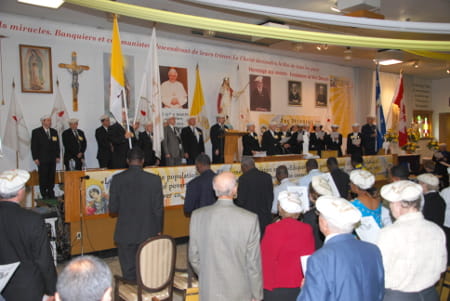
Rougemont Quebec Monthly Meetings
Every 4th Sunday of every month, a monthly meeting is held in Rougemont.


 Subscribe