


It is important to clearly distinguish between these two terms. Secularity means that the State has no official religion, but that it neither prohibits nor combats religions. The State allows people to live their faith and to express it freely. Secularism, on the other hand, is hostile to all forms of religion and seeks to prohibit any expression or manifestation of religion in public, in schools, and elsewhere.
When we speak of the separation of Church and State, we are referring to the sound distinction between the political sphere and the religious sphere — something that has not always been easy to achieve throughout history. In France, for example, the Revolution of 1789 prohibited any influence of the Catholic religion: this was the period of The Terror, during which priests were even forced, under penalty of death, to swear an oath of obedience to the State rather than to the Pope in Rome. A few years later, Emperor Bonaparte, recognizing that religion was nevertheless necessary for the stability of the State, restored relations with the Church of Rome through the Concordat of 1801. Despite this, an anti-clerical spirit continued to prevail among a large segment of the French political class, and in 1905 Parliament passed the Law on the Separation of Churches and the State.
In 2005, on the occasion of the centenary of this law, Pope Saint John Paul II wrote a Letter to the Bishops of France. Cardinal Jean-Pierre Ricard, then President of the Conference of Catholic Bishops of France, summarized the Pope's letter as follows:
"John Paul II distinguishes between secularity and secularism. The latter is an attitude hostile to all religion, which it views as a humiliation of reason and a source of violence and intolerance… In contrast to secularism, it is important to clearly define the correct understanding of the principle of secularity, 'which also belongs,' the Holy Father says, 'to the social doctrine of the Church.' It expresses the non-confessional nature of the State and the proper autonomy of both the State and the Church. The State does not interfere in the internal life of the Church, and likewise the Church does not normally intervene in the functioning of the State and public authorities, except when respect for the foundational principles of our social life is at stake. This autonomy does not mean mutual ignorance, but dialogue."
In his apostolic exhortation on the Church in the Middle East (September 14, 2012, no. 29), Pope Benedict XVI wrote: "A heatlhy secularity… frees religion from the encumbrance of politics, and allows politics to be enriched by the contribution of religion, while maintaining the necessary distance, clear distinction and indispensable collaboration between the two spheres. No society can develop in a healthy way without embodying a spirit of mutual respect between politics and religion, avoiding the constant temptation either to merge the two or to set them at odds… Both spheres should be marked by a kind of unity in distinction, inasmuch as both are called, while remaining distinct, to cooperate harmoniously in the service of the common good. This kind of healthy secularity ensures that political activity does not manipulate religion, while the practice of religion remains free from a politics of self-interest which at times is barely compatible with, if not downright contrary to, religious belief. For this reason, a healthy secularity, embodying unity in distinction, is necessary and even vital for both spheres."
Study Session on Economic Democracy And Annual Congress
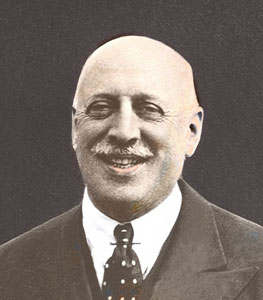
Discover C.H. Douglas’s proposals for economic and social renewal with the Pilgrims of St. Michael in Rougemont, Quebec Canada from Sept. 23 through September 28 2026.
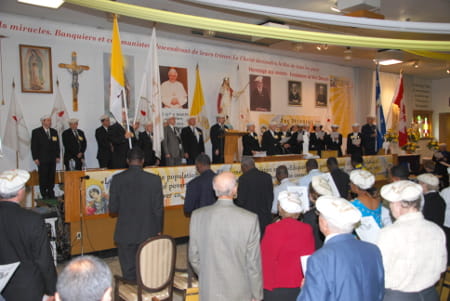
Rougemont Quebec Monthly Meetings
Every 4th Sunday of every month, a monthly meeting is held in Rougemont.

 Subscribe