






Look at the cartoon above: a store filled with good things. Abundance. In front of the store, a starving man. Deprivation. The good things are made to be consumed. The merchant displays them in order to sell them. The consumer would like to buy them. But he lacks permission to do so. He has no money. The result: the good things will not be consumed but will rot on the shelves. And yet everyone would be happy if it were otherwise. The merchant would be happy to sell. The consumer would be happy to buy. Why then does something that would bring happiness to all fail to take place among human beings?
Let us look instead at monkeys. They see abundance in the trees. They need these things in order to live. They simply use them.
And yet monkeys have never developed, in their universities, learned economic systems. In their monkey minds they have never reasoned about the law of supply and demand, nor about the difference between Communism and neo-liberalism. They find themselves in front of good things meant for them and see sufficient reason not to starve.
But a monkey is a monkey, and a man is a man. The first has no intellect. The second can abuse the intellect he has. The monkey is guided by instinct, which does not deceive him. Man is guided by his intellect, often thrown off balance by pride. So man quibbles, engages in dialectics, but forgets simple reasoning based on common sense.
Certainly, this great absurdity — multitudes starving in the midst of abundant wealth — is caused by the greed of those who establish power upon the enslavement of the masses. But it can also be said that this absurdity is defended and maintained by so-called experts in economics who lead minds to the most foolish conclusions while appearing to reason with science and wisdom.
Gilberte Côté-Mercier
This entire absurd situation can be summarized in the form of a story, but one that carries a very serious conclusion:
A group of monkeys in the jungle were discussing among themselves whether humans were more intelligent than monkeys. Some said yes; others said no. One monkey cried out: "To settle the matter, I will go into the city among the humans and see whether they are really more intelligent than we are." All the monkeys agreed to his proposal.
So the monkey went into the city and saw a penniless man starving in front of a store filled with bananas. The monkey returned to the jungle and said to the others:
"Do not worry — humans are not more intelligent than we are. They starve in front of bananas that have already been picked and placed at their disposal on store shelves."
Monkeys cannot understand why humans starve in front of available bananas; for them it remains a profound mystery. It is because they are unaware of the rule humans have imposed upon themselves — the rule that one must pay money in order to obtain products, including bananas.
That rule can function very well, provided humans have enough money to purchase at least the necessities of life. But under the present financial system, this is unfortunately not the case, as has often been explained in various issues of MICHAEL
Money is important in today's world not because it is wealth, but because wealth is not distributed without money. Wealth — useful goods — may mock you while you starve in front of bursting granaries if you have no money. No money, no products: man will die of hunger, and the products will be discarded.
Conclusion: for heaven's sake, let us be more intelligent than monkeys, and design a monetary system that will allow us to eat the bananas and all the other products that God gives in abundance to all His children on earth.
Money is essentially a matter of accounting and must be issued according to the country's production — for example, as much money as there are bananas, so that the bananas can be purchased. Such a monetary system exists; it is the one promoted by MICHAEL, known as Economic Democracy.

Alain Pilote has been the editor of the English edition of MICHAEL for several years. Twice a year we organize a week of study of the social doctrine of the Church and its application and Mr. Pilote is the instructor during these sessions.
 In this special issue of the journal, MICHAEL, the reader will discover who are the true rulers of the world. We discuss that the current monetary system is a mechanism to control populations. The reader will come to understand that "crises" are created and that when governments attempt to get out of the grip of financial tyranny wars are waged.
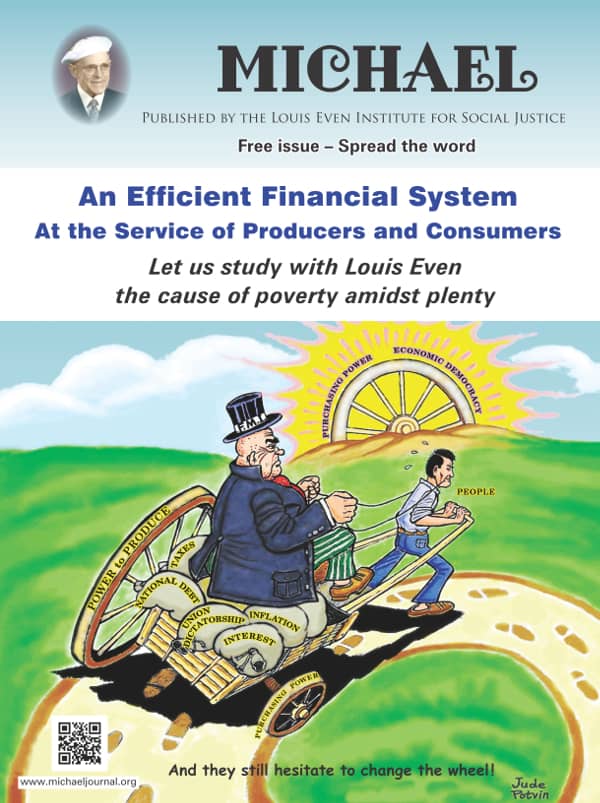 An Efficient Financial System, written by Louis Even, is for the reader who has some understanding of the Douglas Social Credit monetary reform principles. Technical aspects and applications are discussed in short chapters dedicated to the three propositions, how equilibrium between prices and purchasing power can be achieved, the financing of private and public production, how a Social Dividend would be financed, and, finally, what would become of taxes under a Douglas Social Credit economy. Study this publication to better grasp the practical application of Douglas' work.
  Reflections of African bishops and priests after our weeks of study in Rougemont, Canada, on Economic Democracy, 2008-2018
 The Social Dividend is one of three principles that comprise the Social Credit monetary reform which is the topic of this booklet. The Social Dividend is an income granted to each citizen from cradle to grave, with- out condition, regardless of employment status.
 Economic Democracy is a book to explain Social Credit in lessons presented in logical order so it may be easier to the reader to grab the main principles of Social Credit rapidly and somehow easily.
 In This Age of Plenty deals with Social Credit, but it does not exhaust the topic. Social Credit principles address social and political matters, as well as, or even more so, than economics and will put civilization on a new course.
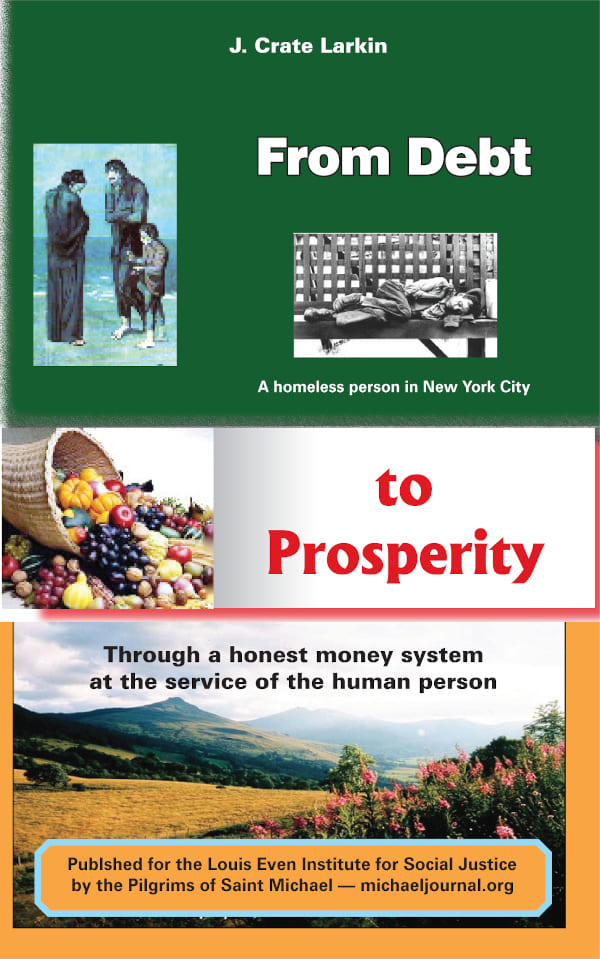 From Debt to Prosperity outlines briefly the economic analysis and constructive proposals known as Social Credit.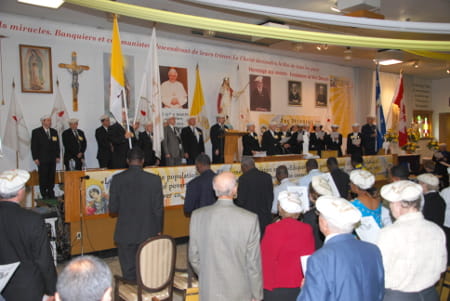
Rougemont Quebec Monthly Meetings
Every 4th Sunday of every month, a monthly meeting is held in Rougemont.
 Subscribe